
One UK agency lists £1,500 for a single workflow and up to £40,000 for a full programme. Another says its builds start at $7,500. Both sell workflow automation services, and you can't tell which number is fair for your process.
The quote matters less than you think. One number decides whether automation pays back: how many times a month the work happens. Searches for workflow automation services rose more than sevenfold in a year (+662%), so many buyers are asking the same question.
Below are 2026 prices checked on vendor pages, what buyers really pay, and a volume rule you can apply in two minutes.
What do workflow automation services cost in 2026?
Workflow automation services cost £1,500 to £5,000 for one simple workflow at a UK agency, while another lists $5,000 to $20,000 for one to three. Add the platform: median buyers pay $15,000 a year for Zapier and $45,338 for UiPath. Upkeep adds £300 to £800 a month.
The agency figures are self-published price lists, not audited data. The platform medians come from Vendr, a software-buying service that publishes what its customers paid.
What you are paying for: four lines, not one
Every automation quote has four parts. Ask for each as a separate line, because the build is the only one that ends.
- Build: discovery, design, building and testing. You pay it once.
- Platform licence: Zapier, n8n, Power Automate or UiPath. You pay it every year, and it grows with volume.
- Run: hosting and AI model fees. AutomateNexus, an agency, puts AI model usage at $30 to $150 a month.
- Maintenance: fixing the flow when a screen or API changes. Softomate, a UK agency, lists retainers of £300 to £800 a month.
Don't judge a quote on the build line alone. In our worked example below, three years of running costs come to $23,400. That is nearly as much as the $25,000 build.
Platform prices: list price vs what buyers really pay
List prices look tiny, but real contracts are far larger. The median Zapier buyer pays $15,000 a year, about 62 times the $240 a year of its cheapest paid plan.
Bigger task tiers, more seats and add-ons close that gap. Prices below were checked on each vendor's own page on 12 November 2026. The medians come from Vendr's transaction data for Zapier and its UiPath and Workato pages.
| Platform | List price (checked 12 Nov 2026) | Median paid per year | Data behind the median |
|---|---|---|---|
| Zapier | Professional from $19.99/mo (750 tasks); 2,000 tasks $49/mo; Team from $69/mo; billed yearly | $15,000 (range $4,788–$36,388) | Vendr, 98 purchases |
| UiPath | Basic from $25/mo; Standard and Enterprise via sales | $45,338 (range $22,440–$223,821) | Vendr, 42 purchases |
| UiPath (second source) | As above | SMB average $36,653; enterprise average $335,013 | SpendHound, 160 customers, updated 29 Oct 2026 |
| Workato | Not published (quote only) | $64,544 (range $20,370–$182,649) | Vendr, 345 purchases |
| Power Automate | Premium $15/user/mo; Process $150/bot/mo; paid yearly | Not published | No Vendr page found |
| n8n | Starter €20/mo; Pro €50/mo; Business €667/mo (self-hosted only); billed yearly | Not published | No transaction data found |
| Make | Core about $9/mo, per Vendr's summary | Not published | Not verified on vendor page |
Four details in those pricing pages matter more than the headline numbers.
- Zapier bills overage by default. When you pass your task tier, Zapier's pricing page says you switch to pay-as-you-go unless you turn it off.
- n8n's Business plan is self-hosted only. At €667 a month for 40,000 runs, per n8n's pricing page, you also pay for servers and someone to run them.
- Process mining costs more than the bots. Microsoft's Power Automate price list puts its Process Mining add-on at $5,000 per tenant a month. That is $60,000 a year.
- UiPath's entry plan is in flux. UiPath's pricing page lists Basic from $25 a month but says an updated plan is coming soon.
Pricing is also moving toward paying per use and per outcome. From 15 June 2026, Zapier's help centre says AI steps cost 1, 3 or 5 tasks per run, depending on the model tier. The default tier costs 3.
On 2 November 2026, UiPath said it will charge its new finance agents per document processed, as reported by The Next Web. Those agents arrive in early 2027, and no price has been published yet.
What business automation services cost from agencies
Expect $5,000 to $20,000 for a first small project, but the spread is wide. Every figure below is the agency's own published price, so treat it as a starting point for negotiation.
| Pricing model | What you get | Published price | Source |
|---|---|---|---|
| Per workflow | One workflow, scoped and built in 4–6 weeks | £1,500–£5,000 | Softomate, UK agency (self-reported, Oct 2026) |
| Small project | 1–3 simple workflows on Zapier or Make, 2–6 weeks | $5,000–$20,000 | RaftLabs, agency (self-reported, Aug 2025) |
| Fixed build | Custom build with logic and error handling | From $7,500 one-off | AutomateNexus, agency (self-reported, Oct 2026) |
| Programme | Several processes, 12–20 weeks | £15,000–£40,000 | Softomate (self-reported) |
| Retainer | Monitoring, fixes and small changes | £300–£800 a month | Softomate (self-reported) |
| Hourly | Ad-hoc fixes with no retainer | £75–£150 an hour | Softomate (self-reported) |
| Hourly, directory | Top 15 RPA consultancies listed on Clutch | $25–$49 up to $200–$300 an hour | Clutch listings, 12 Nov 2026 |
| Independent anchor | Senior outsourced developer | Asia $31–$41; Latin America $60–$75; Europe $64–$76 an hour | Accelerance 2026 rate guide |
Use the Accelerance 2026 outsourcing rate guide as a sanity check. A $25,000 build buys about 610 to 810 hours at Asian senior rates. At European senior rates it buys about 330 to 390 hours.
Ask every agency how many hours its quote assumes. If the hours look thin, so is the testing. Our AI agent development cost guide breaks down where those hours go on larger builds.
Worked example: when workflow automation services pay back
The scenario: sales-order entry at a distributor (illustrative)
Take a US distributor that receives 3,000 orders a month as PDFs and emails. These are the inputs:
- A clerk spends 7 minutes keying and checking each order.
- Loaded labour cost is $34.80 an hour. That is the BLS median wage for bookkeeping clerks, $24.36 in May 2025, divided by 0.70.
- The 0.70 is the wage share of total pay costs, from BLS compensation data for June 2026.
- 80% of orders go straight through, meaning the system enters them with no human touch.
- Exceptions take a clerk 3 minutes each. A 5% spot check of automated orders takes 1 minute each.
The cost inputs are illustrative assumptions, not quotes. Swap in your own:
- Build: $25,000.
- Run cost: about $650 a month. That covers n8n Pro (€50, about $58), AI extraction (3,000 orders at $0.03, so $90) and a $500 maintenance retainer.
The arithmetic
- Manual cost: 3,000 × 7 minutes = 350 hours. 350 × $34.80 = $12,180 a month.
- Exceptions: 20% of 3,000 = 600 orders. 600 × 3 minutes = 30 hours.
- Spot checks: 5% of the 2,400 automated orders = 120 orders. 120 × 1 minute = 2 hours.
- Human time left: 32 hours × $34.80 = $1,114 a month.
- Net saving: $12,180 − $1,114 − $650 = $10,416 a month.
- Payback: $25,000 ÷ $10,416 = 2.4 months.
Now drop the straight-through rate to 50%. Human time rises to about 76 hours, yet payback only stretches to 2.8 months. At 3,000 orders a month, almost any sound build pays back fast.
The volume rule
Volume changes the answer far more than accuracy does. Each order here saves 6.36 minutes of clerk time, worth $3.69.
Minutes saved per item are your manual minutes minus the human minutes left. Here that is 7 − (0.20 × 3) − (0.80 × 0.05 × 1) = 6.36 minutes.
The rule in words: monthly saving = volume × minutes saved ÷ 60 × hourly cost − monthly run cost. Then payback in months = build cost ÷ monthly saving.
The table holds run cost at $650 at every volume. That is cautious, because the AI fee shrinks as volume falls.
| Orders a month | Monthly net saving | Payback on a $25,000 build |
|---|---|---|
| 150 | −$97 (loses money) | Never |
| 176 | About $0 | Never (only covers run cost) |
| 300 | $457 | 55 months |
| 500 | $1,194 | 21 months |
| 741 | $2,083 | 12 months |
| 1,500 | $4,883 | 5.1 months |
| 3,000 | $10,416 | 2.4 months |
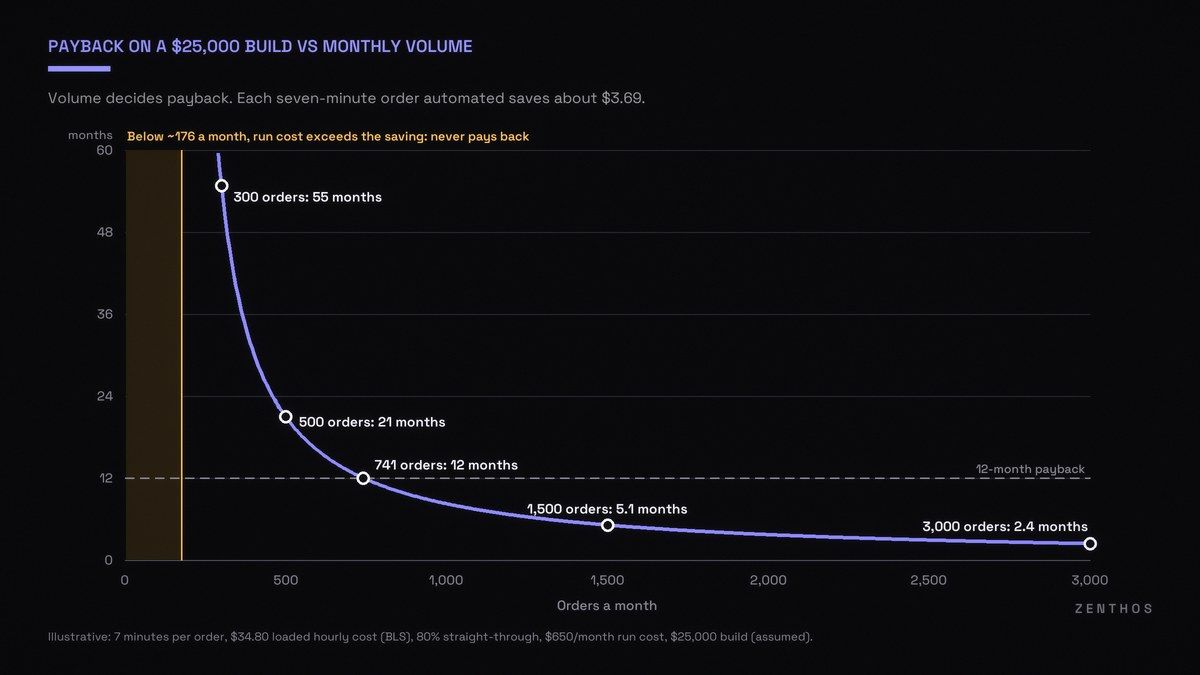
Remember two thresholds for a seven-minute task. Below about 176 items a month, the automation costs more to run than it saves. You need about 741 a month to pay back a $25,000 build within a year.
Check: (25,000 ÷ 12 + 650) ÷ 3.69 = 741. For a different task time, rerun the formula with your own minutes.
The cash view: will business automation cut headcount?
Probably not, and that changes your payback. Time saved only becomes cash when it removes a salary you would otherwise pay.
In the example, 318 hours a month are freed (350 − 32). A full-time employee works about 173 hours a month (2,080 ÷ 12). So the build frees 1.83 FTE, or full-time equivalents.
What happens next decides your real return:
- Avoid a hire. Don't backfill one clerk who leaves, and you bank $6,032 a month (173.3 × $34.80). Payback is $25,000 ÷ ($6,032 − $650) = 4.6 months.
- Redeploy staff. People move to better work. That can be the right call, but no cash comes back. You are paying $650 a month for capacity.
- Cut roles. This is rare in practice, as the survey below shows.
The New York Fed's September 2026 business survey backs this up. 61% of regional service firms now use AI, up from 40% a year earlier.
Yet only 4% of those service firms laid off workers because of AI. About 15% hired fewer people than they would have, and about 13% hired more.
So build your business case on hires you will not make. Name the avoided role in the budget before you sign, or the saving fades into spare time.
When business process automation does not pay
Five patterns sink the payback. Check for each before you buy.
1. Low volume
Below about 176 seven-minute items a month, you lose money on run costs alone. A monthly report that takes two hours saves at most $70 a month at $34.80 an hour. Twelve runs a year cannot carry a build.
2. Unstable screens
Bots that click through screens break when a screen changes. A 2020 Forrester study, paid for by testing vendor Tricentis, found 45% of firms saw bot breakage weekly or more often.
The study is old and vendor-funded, but the cause still holds. Prefer APIs, the direct system-to-system links, wherever they exist.
3. Licences nobody uses
Redress Compliance, a licensing consultancy, reviewed 12 to 18 UiPath contracts from 2024 and 2025. Licences tied to retired automations made up 10–20% of renewal value. Audit what still runs before every renewal.
4. Per-task pricing that grows with steps
Zapier counts one task for each action step. n8n counts one execution per run, however many steps it has. Take our 3,000 orders through a trigger plus 10 action steps:
- Zapier: 3,000 × 10 = 30,000 tasks. That needs the 50,000-task Professional tier, at $289 a month billed yearly.
- Zapier, 2 steps: 3,000 × 2 = 6,000 tasks. That fits the 10,000-task tier, at $129 a month.
- n8n: 3,000 executions either way. That fits Pro, at €50 a month for 10,000 runs.
Adding eight steps more than doubled the Zapier bill. On n8n it changed nothing. AI steps that use 3 or 5 tasks each widen the gap further.
5. Discovery tools that cost more than the bots
Process mining is software that reads system logs to map how work really flows. Microsoft's add-on lists at $60,000 a year, more than double our example build. For one or two processes, a few hours watching a clerk work tells you enough.
RPA vs workflow tools vs AI agents: which business automation fits?
Pick the tool by the input, not the sales pitch. Here are the three options in plain terms:
- RPA (robotic process automation) is software that clicks through screens like a person.
- A workflow tool connects apps through their APIs.
- An AI agent is an AI model that reads messy input and decides the next step.
| Your process | Best fit | Why | Watch out for |
|---|---|---|---|
| Rule-based, stable screens, no API | RPA (UiPath, Power Automate Process) | Works on old systems with no API | Breaks when screens change; per-bot licences |
| App to app, both have APIs | Workflow tool (n8n, Zapier, Make) | Cheapest to build and run | Per-task bills grow with steps |
| Unstructured input or judgment calls | AI agent with human review | Handles variation in documents and emails | Needs exception routing and accuracy checks |
| Messy input, then system entry | AI extraction feeding a workflow tool | AI reads; the workflow posts the result | Two bills: model fees plus platform |
Our order example is the last row. If your workflow tool keeps hitting its limits, read when you have outgrown n8n and need a custom AI agent.
For how an agent differs from a scripted bot, see AI agent vs chatbot. Invoices follow the same maths, which we cover in our AI invoice processing guide.
Seven questions to ask an automation company
Business process automation companies vary most in what happens after go-live. Get these answers in writing:
- Who owns the code and the platform licences after go-live?
- When a source app's screen or API changes, how fast do you fix it, and is that in an SLA?
- What straight-through rate is the acceptance test?
- How are exceptions routed, and to whom?
- Is pricing per task, per run or per bot, and what does it cost at three times today's volume?
- Where does our data go: which AI model, which region, and is there a data processing agreement?
- What does it cost to leave, and do we get a handover runbook?
Want the maths on one page? Download the automation payback worksheet and fill in your volume, minutes and quote.
FAQ
How much do workflow automation services cost?
Published agency prices run from £1,500 to £5,000 for one simple workflow and $5,000 to $20,000 for one to three. Platform licences add more: median buyers pay $15,000 a year for Zapier and $45,338 for UiPath, per Vendr. Upkeep retainers start around £300 a month, and all agency figures are self-reported.
How long until automation pays for itself?
Volume decides it. For a seven-minute task at $34.80 an hour, a $25,000 build pays back in 2.4 months at 3,000 items a month. It takes 12 months at about 741 items, 55 months at 300, and never below about 176.
Is Zapier or n8n enough, or do I need a custom build?
If both apps have APIs and the input is structured, a workflow tool is usually enough and cheapest. Long flows cost more on Zapier, which bills per task, than on n8n, which bills per run. Messy inputs like PDF orders need AI extraction or a custom agent on top.
What does automation maintenance cost each year?
Agency retainers are published at about £300 to £800 a month, or roughly £3,600 to £9,600 a year. Ad-hoc fixes without a retainer run £75 to £150 an hour at one UK agency. Screen-based bots usually need more upkeep than API-based flows, because screens change more often.
Will automation let me reduce headcount?
Rarely: the New York Fed's 2026 survey found only 4% of AI-using service firms laid people off, while about 15% hired fewer. Plan savings as avoided hires, not cuts. If you only redeploy staff, the automation adds capacity but returns no cash.
RPA or AI agents: which is cheaper to run?
For stable, rule-based screens, RPA is predictable: Power Automate lists unattended bots at $150 a month each. AI agents add model fees per item, such as the $0.03 an order assumed in our example. Agents cost more per item but cope with messy input that would break a bot.
Find out if your process pays back
The right automation is often smaller than the first quote, and sometimes the right answer is not to automate at all.
Zenthos builds RPA and workflow automation, agentic AI systems and AI and machine learning solutions for operations and finance teams.
Book a free consultation. Tell us the process, the monthly volume and the minutes per item, and we will tell you if it pays back. That includes when the answer is no.