
You have been pitched an AI agent at least five times this quarter. Ask each of those vendors the same question, what is an AI agent, and you will get five different answers, three of which describe a chatbot in a trench coat. That would be a harmless argument about labels if the price tags matched. They do not. The distance between the cheapest thing that solves your problem and the most expensive thing being sold to you is routinely a factor of ten.
The confusion pays well for the people selling. Gartner estimated in mid-2025 that of the thousands of vendors describing themselves as agentic, only around 130 offered genuine agentic capability; the rest were rebranding chatbots, robotic process automation and rule engines. Gartner gave the practice a name, agent washing, and in the same research predicted that more than 40% of agentic AI projects would be cancelled by the end of 2027, largely over escalating costs and unclear business value. Those two findings are one finding. Projects die when a business buys the fourth rung of the ladder for a problem sitting on the second.
Zenthos builds both. We ship chatbots and we ship agents, so nothing here is trying to move you up a tier. What follows is the capability ladder in plain English, an honest cost picture, the failure modes that never reach slide nine, and five questions that expose agent washing inside four minutes of a sales call.
What is an AI agent?
An AI agent is software that pursues a goal across several steps and takes real actions in your systems: booking the appointment, issuing the refund, updating the CRM record, rather than only producing text. A chatbot answers a question. An agent answers it and then does the work that follows.
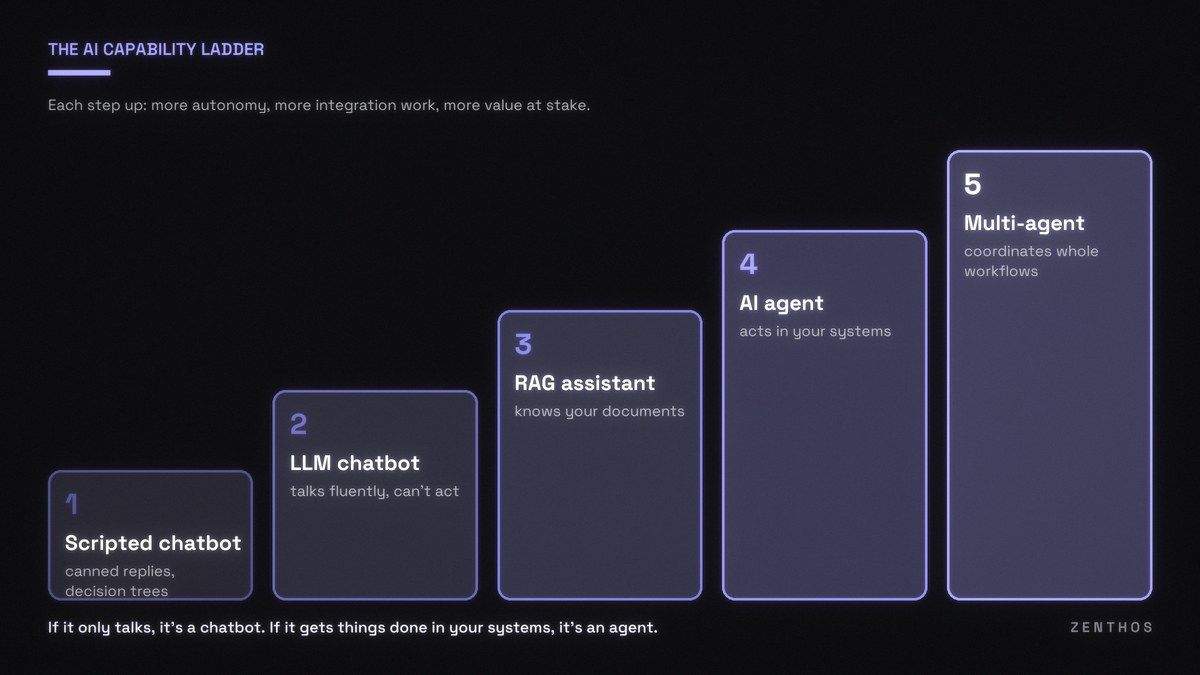
Between those two poles sit three more rungs, and the rung you actually need is usually not the one on the brochure. Read this ladder as a price curve, because that is what it is.
- Scripted chatbot. Decision trees and canned replies. It handles the questions somebody anticipated in advance and breaks the moment a customer phrases things a way the script did not expect. Cheap, predictable, quietly infuriating at scale.
- LLM chatbot. A large language model, the technology behind ChatGPT, wrapped in a chat window. Fluent, plausible, good at general knowledge, and completely ignorant of your refund policy, your stock levels and your opening hours. It cannot do anything either.
- RAG assistant. RAG, or retrieval-augmented generation, means the system searches your own documents before answering rather than relying on what it vaguely remembers. This is the rung where the bot finally knows your business. It still only talks.
- AI agent. Connected to real tools, calendar, CRM, billing, inbox, and pointed at a goal instead of a question. It plans steps, takes actions, checks the result and retries. It is also the first rung where a mistake costs money rather than goodwill, which is why guardrails stop being optional.
- Multi-agent workflow. Several specialised agents coordinating, each owning a slice of a longer process. Worth it when one job is honestly five jobs: intake, verification, pricing, approval, follow-up. Worth avoiding when it is one job you have described ambitiously.
If it only talks, it's a chatbot. If it gets things done in your systems, it's an agent.
That line settles most arguments in a demo. Apply it and you will find that most businesses asking for an agent need the third rung, a few need the fourth for one process and the second for everything else, and almost nobody needs the fifth in year one.
AI agent vs chatbot: the side-by-side that matters
Vendor comparison tables are built around dimensions that make demos look good. Here are the dimensions that change your invoice and your risk.
| Dimension | Chatbot | AI agent |
|---|---|---|
| What it does unprompted | Nothing. It waits for a human to open the chat window and type first. | Watches for a trigger and starts work on its own: a new ticket, an overdue invoice, a missed call. |
| Connection to your systems | None, or read-only access to help articles and product data. | Read and write access to calendar, CRM, billing and inbox, with credentials and permissions to manage. |
| Memory | Forgets everything when the tab closes. Each conversation starts from zero. | Carries state across steps, sessions and systems, so it can resume a half-finished job. |
| Typical monthly cost tier | $ | $$$ (plus a one-off build) |
| What breaks it | A question outside its script or outside your documents. Fails visibly and cheaply. | A system that changed on the other end, an expired permission, an unmapped edge case. Fails quietly. |
| Best first use case | Deflecting the twenty questions your team answers every single day. | One end-to-end task you can describe in a single sentence and audit afterwards. |
Read the memory row twice, because it quietly decides feasibility. Anything spanning more than one sitting, chasing an invoice over three weeks, rescheduling a customer who replies at midnight, needs a system that remembers where it got to. A chatbot with no memory can look brilliant in a demo and be structurally incapable of the job.
The failure row is the one buyers skip and then meet in month three. When a chatbot fails, a customer sees a bad answer and asks for a human. When an agent fails, nobody sees anything. A common failure mode is an agent replying confidently while the calendar it is meant to be writing to has been silently rejecting its requests for a week, discovered when three customers arrive for appointments that were never booked. That gap, visible cheap failure against invisible expensive failure, is most of what you pay for by climbing the ladder. You are not buying more intelligence. You are buying the monitoring, permissions and fallbacks that make actions safe.
What about RPA? RPA vs AI agents, without the acronyms
RPA, robotic process automation, is software that replays exact clicks and keystrokes. You record a person doing a task, and the robot repeats those motions, identically, forever. It does not understand the task. It reproduces the choreography.
That makes RPA reliable and brittle at once. Reliable because it does precisely the same thing every night. Brittle because the day a supplier portal moves a button forty pixels to the left, the robot carries on clicking empty space. Agents reason about intent; RPA repeats a recording. When the screen changes, an agent can often work out the new path and a robot cannot.
None of which makes RPA the loser. For stable, high-volume, rule-based back-office work, reconciling the same three report formats every night, keying supplier invoices into a system with no usable integration, RPA is cheaper to deploy, easier to audit and far less likely to surprise you. If you can write the rule down completely, with no sentence beginning "unless", you do not need something that reasons. That is why our RPA practice sits alongside the agent work: a meaningful share of what arrives described as agentic is a clean automation job at a fraction of the price.
The trap runs the other way too. A process with dozens of exceptions, each currently handled by a person exercising judgement, turns RPA into a maintenance burden: every exception is another branch, and within a year somebody spends their Fridays nursing robots. Count the exceptions before you choose. Few favour RPA; many, each needing a judgement call, favour an agent.
Which does your business need?
Start from the job, not the technology. Below is the mapping worth arguing with, including a cheaper stepping stone for every row, because the stepping stone often turns out to be the whole answer.
| The job to be done | Right tier | Start here instead |
|---|---|---|
| Answering the phone after hours | Voice AI receptionist (a narrow agent) | A published after-hours number with voicemail-to-text and a morning callback list. |
| FAQ deflection on your website | LLM chatbot | Fix the top ten help pages first, then measure what people still ask. |
| Answers from internal policy documents | RAG assistant | One well-maintained internal FAQ page and a working search box. |
| Appointment booking and rescheduling | AI agent with calendar write access | A chatbot that hands over a self-service booking link and stops there. |
| Chasing unpaid invoices | AI agent connected to billing and email | Scheduled reminder sequences from the accounting tool you already pay for. |
| Qualifying inbound leads | RAG assistant, or a light agent that writes to the CRM | A chatbot with a short qualifying form and hard routing rules. |
| Complex multi-system back office | Multi-agent workflow | One agent doing only the single most painful step in the chain. |
The after-hours row is the one businesses get wrong in both directions. An AI receptionist subscription typically runs roughly $50 to $600 a month against $250 to $1,700 or more for a human answering service, and we published the full cost and ROI breakdown rather than a calculator designed to flatter the product. What no comparison can tell you is whether missed calls are actually costing you booked work. If your phone rings four times a day and nobody calling is in a hurry, the stepping stone in column three is the correct purchase.
Take that third column seriously. Every stepping stone in it produces the thing you need before buying the expensive tier: evidence. Ninety days of chatbot transcripts tell you which questions actually arrive, which ones need an action rather than an answer, and how often your process fails. Buy an agent after that and you are specifying a system. Buy one before, and you are guessing with a budget.
What is an AI agent going to cost, and where does the money go?
A chatbot is a subscription. You pay monthly, the vendor absorbs the engineering, and your costs after go-live are content upkeep and the licence. An agent is a build. You pay for integration work, for the permissions and error handling wrapped around every connected system, for monitoring, and for somebody who owns it when it misbehaves at two in the morning. Those are different financial instruments, not two prices for the same product.
The line that surprises buyers is which one dominates, because it is almost never the model. Usage costs are real and usually a modest entry next to integrations and edge cases. Connecting to a calendar is a day of work. Connecting to a calendar and correctly handling double bookings, appointments cancelled then reinstated, two customers with the same name, the person who replies "next Tuesday" on a Wednesday, and the quarter your CRM changes its interface, that is the project.
We broke the real build costs down with line items in our guide to what AI agent development actually costs, so there is no need to repeat figures here. The budgeting principle is simpler than the numbers anyway: an agent is software you now own, not a subscription you can cancel in a bad quarter. Plan the second year, not just the launch. A proposal with no line for monitoring and maintenance is not a complete proposal.
The cheapest defensible sequence is boring. Buy the subscription tier. Watch what happens for a quarter. Then build one agent for the single workflow your own transcripts prove is expensive, and let it earn the second one.
Five questions that expose agent washing
You do not need technical knowledge to run this test, only five questions and the patience to notice when an answer changes the subject. In each case the good answer is specific about your situation; the evasive answer is impressive about the product.
- 1. Can it take an action in a system I already use, end to end? A good answer names your systems, describes the exact write operation, and offers a live demonstration against a test account. An evasive answer is "we integrate with 200+ apps", which usually means a generic connector nobody has run against your setup. Ask them to do it while you watch.
- 2. What happens when it is not sure? A good answer describes a confidence threshold, a handoff and a queue: below a certain certainty it stops and a named human picks it up. An evasive answer is "it doesn't get confused". Every system that acts in the real world has an I-don't-know path, and a vendor who cannot describe theirs has not built one.
- 3. Show me a failure log. A good answer is a screen with timestamps and genuinely ugly cases on it, plus what changed afterwards. An evasive answer is an aggregate accuracy percentage, or "we can arrange that later". Anyone running real agents reviews failure logs weekly, so they are never more than a click away.
- 4. What does it cost when volume doubles? A good answer separates fixed from variable and names the meter that moves: per conversation, per action, per connected system. An evasive answer is "it scales". Doubling volume is the most predictable thing that will happen to a successful deployment, and it is where thin margins become expensive surprises.
- 5. What do humans still handle? A good answer is a specific out-of-scope list delivered without embarrassment: refunds above a threshold, anything involving a complaint, the first call from a new enterprise account. An evasive answer is "full automation", or a pause. A vendor who cannot name what their system should not touch has not thought about what happens when it does.
Run all five and the picture resolves fast. Genuine vendors get more concrete as you press. Agent-washed products get more visionary, because the roadmap is the only place the capability exists. We keep these on a single page, so download the checklist and take it into the next demo.
Can AI replace customer service teams, honestly?
Yes for coverage. Substantially for the repetitive tier. No for judgement, and the third one is where the business case usually lives.
Coverage is the easy win and the one most businesses underrate. Nobody staffs the gap between five in the afternoon and nine the next morning, and every message landing in it cools off overnight. Filling that window costs a fraction of a night shift and needs nothing cleverer than a well-grounded assistant. The repetitive tier is next: where is my order, how do I reset this, what are your hours, what is the returns window. That volume is enormous and the least satisfying part of anyone's job.
Judgement is where the honest answer stops. The customer who is angry for a reason your policy does not cover, the case where the right decision costs you money on purpose because the relationship is worth more than the refund, the complaint that is really about something else, these are not hard text problems. They are decisions about what kind of company you are, and automating them produces a technically correct answer that loses the customer.
The realistic outcome is a smaller team doing harder work with better tools, not an empty room, and we have argued that case at length in why AI does not replace your support team. The failure mode to avoid is deflecting so aggressively that reaching a person becomes an obstacle course. Customers remember that far longer than a slow reply.
FAQ
Is ChatGPT an AI agent?
By default, no. ChatGPT is a large language model in a chat window: it talks, it reasons about text, and it forgets your business the moment you close the tab. It becomes agent-like only when it is connected to your tools with permission to act, and that connection is a build, not a login.
The distinction matters commercially, because "we use ChatGPT" and "we run an agent" describe wildly different amounts of work. The model is the cheap part. The plumbing, the permissions and the behaviour when something goes wrong are the expensive parts, and none of them arrive with the subscription.
What is agent washing?
Agent washing is rebranding software that cannot act, such as chatbots, rule engines and RPA scripts, as an AI agent. Gartner flagged the practice in mid-2025, estimating that only about 130 of the thousands of vendors calling themselves agentic actually offered agentic capability. The label inflates the price, not the capability.
How much does an AI agent cost compared to a chatbot?
A chatbot is a monthly subscription with predictable pricing. An agent is a build: integration work, guardrails, monitoring and ongoing ownership, typically an order of magnitude more in year one. The cost driver is integrations and edge cases rather than the AI model itself, which is why quotes vary so widely for similar-sounding requests.
Do I need an AI agent or just a chatbot?
Ask what success requires. If success means somebody gets a correct answer, you need a chatbot or a document-grounded assistant. If success means something changes in your calendar, CRM or billing system without a human retyping it, you need an agent. Most businesses need the first for almost everything and the second for one workflow.
If you cannot name that one workflow in a single sentence, you are not ready to buy an agent. You are ready to buy the cheaper tier and collect ninety days of evidence about which workflow it should be.
Can an AI agent replace my customer service team?
It can replace coverage gaps and the repetitive top tier of questions, typically your highest-volume and lowest-judgement contacts. It cannot replace the calls where somebody is angry, the policy is ambiguous, or the right answer costs you money on purpose. Plan for a smaller team handling harder work, not an empty room.
Teams that get this right hold the escalation path sacred: one clear route to a human, no maze, and full context handed over so the customer never repeats themselves.
Where to start, and how we can help
The uncomfortable truth in this market is that the label on the pitch tells you almost nothing about what the software does, while the price difference between labels is enormous. Use the ladder, run the five questions, and start one rung below where the vendor is pointing. You can always climb. Climbing down is what shows up in that 40% cancellation figure.
Zenthos builds across the whole ladder rather than selling one rung of it. If the job needs reasoning and actions across your systems, that is our agentic AI work. If it is the phone, and for a lot of small businesses it is the phone, that is voice AI. If the underlying problem is your data, forecasting or classification rather than conversation at all, that lands with our AI and machine learning team.
If you would rather not work out which rung you are on alone, tell us about the job in a free consultation. Describe the task the way you would explain it to a new hire, and we will tell you the cheapest tier that genuinely does it. Often enough that answer is an off-the-shelf chatbot at a couple of hundred dollars a month and no build at all, which is a perfectly good outcome for a conversation with an AI company.