
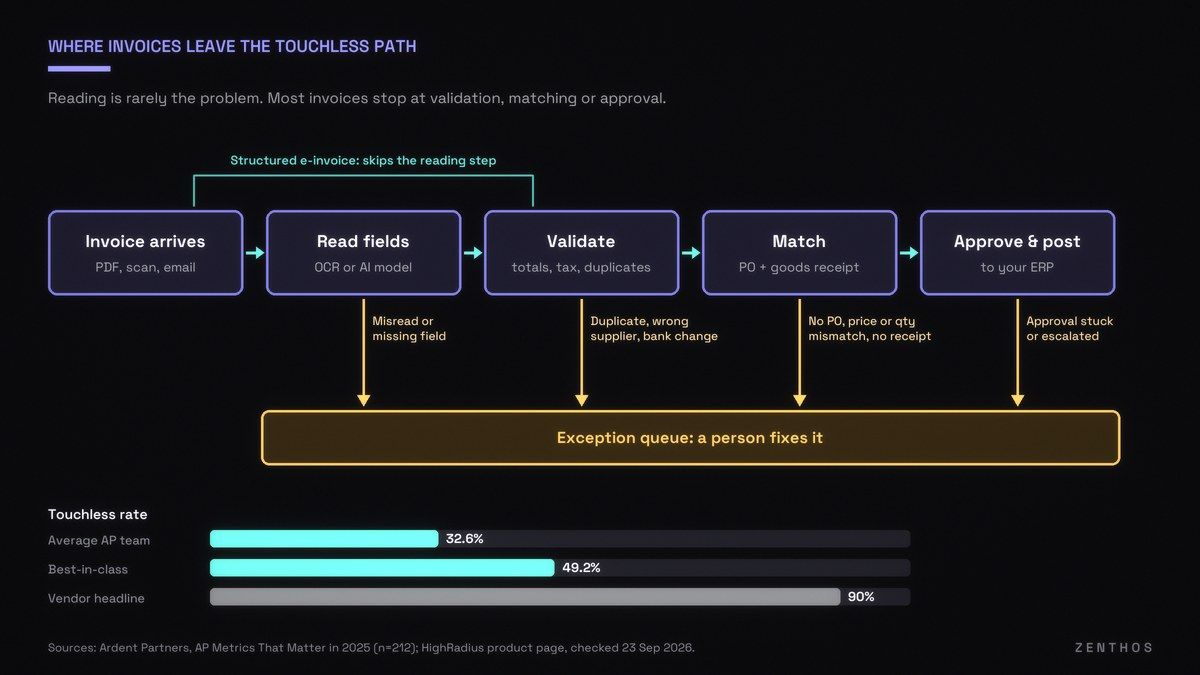
Vendors selling AI document processing promise a lot. HighRadius headlines its invoice software with "90% touchless invoice processing". Others quote 95% to 99% extraction accuracy. The best independent benchmark says the average touchless rate is 32.6%. Even the top fifth of accounts payable (AP) teams only reach 49.2%.
Those figures come from Ardent Partners' AP Metrics That Matter in 2025, a survey of 212 AP and finance leaders. The same survey found that 55% of teams already use automated data capture such as OCR. So reading invoices is largely solved. Something else is stopping them.
Interest is exploding anyway. Searches for "AI document processing" are up about 30-fold in a year, according to Google Keyword Planner. This guide gives you the numbers a demo will not: real accuracy, prices checked on 23 September 2026, and a payback model you can rerun with your own volumes.
What is AI document processing, and what does it cost?
AI document processing is software that reads invoices and other documents and turns them into clean data for your finance system. Reading is cheap: $0.01 a page on AWS or Azure in September 2026. Fixing exceptions is not. That is why the average invoice still costs $9.40 to process.
The industry name is intelligent document processing (IDP). It means software that reads a document, pulls out the fields, checks them against your records and sends anything it cannot handle to a person. Plain OCR (optical character recognition) only turns a picture of text into text. IDP adds the "understand and check" steps.
Two numbers matter, and sales decks tend to blur them:
- Field accuracy is the share of single fields, like invoice number or total, that the software reads correctly.
- Touchless rate is the share of invoices that go from inbox to ready-to-pay with no human touch. It is also called straight-through processing.
Field accuracy is a software number. Touchless rate is a business number. Only the second one cuts your cost.
Why 99% accuracy still means most invoices need a human
Accuracy compounds. An invoice is only touchless if every field on it is right, so the per-field rate gets multiplied across the whole page.
Take an invoice with 20 fields you care about: supplier, invoice number, date, purchase order (PO) number, tax, total and a few line items. At 98% accuracy per field, the chance that all 20 are right is 0.98 multiplied by itself 20 times. That comes to 0.67. So one invoice in three still has at least one wrong field.
A 10-line invoice easily has 30 fields once you count quantity, unit price and amount on each line. Here is how the share of error-free invoices falls as fields add up.
| Accuracy per field | 10 fields | 20 fields | 30 fields |
|---|---|---|---|
| 99% (a common vendor claim) | 90% of invoices error-free | 82% error-free | 74% error-free |
| 98% | 82% error-free | 67% error-free | 55% error-free |
| 95% | 60% error-free | 36% error-free | 22% error-free |
| 92.7% (best AI model on scanned invoices) | 47% error-free | 22% error-free | 10% error-free |
Vendor claims sit at the top of this table. Extend, which sells document AI, advertises "95 to 99%+" extraction accuracy on invoices. Even at 99%, a quarter of 30-field invoices would need a fix.
The table assumes errors are independent. In practice they bunch up on bad scans, so clean PDFs do better and faxed copies do worse. The direction holds either way.
The 92.7% figure comes from a Fraunhofer IAIS benchmark published in August 2025. It tested eight AI models from OpenAI and Google on three public invoice and receipt datasets. The best model got 96.5% of fields right on clean digital invoices and 92.7% on scanned ones. Neither Fraunhofer nor its partner institute sells invoice software.
The same study found a trap. Turning the page into text first, then asking the model, cut scanned-invoice accuracy from 92.7% to 64%. Let the model see the image itself.
What this means for you: never accept field accuracy as a stand-in for savings. Ask for the invoice-level rate on your own documents. And insist on confidence scores, a per-field signal of how sure the system is, so that only doubtful fields go to a person.
Where invoice exceptions really come from
Most invoices that stop are not misread. They are read correctly and are still wrong. An exception is an invoice the system cannot approve on its own because something does not match.
In Ardent's survey, exceptions were the top AP challenge, named by 53% of teams. That is a first in the study's 19 years. The average exception rate was 14%. Teams outside the top fifth ran at 22%, against 9% for the best.
Automation has barely reached this step. Only 5% of teams said exception handling was fully automated, the lowest of any AP task Ardent tracked.
Ardent lists the usual causes as coding errors, missing information, slow approvals and missing PO data. Many firms also run a three-way match, where the invoice, the PO and the goods receipt must agree before payment. Each cause has a fix that no OCR engine provides.
| Cause | What it looks like | Fix that works |
|---|---|---|
| No PO or wrong PO number | The invoice cannot be matched, so it sits in a queue | A "no PO, no pay" rule for goods; ask suppliers to quote the PO |
| Price or quantity mismatch | Invoice differs from the PO by cents, freight or a price rise | Match tolerances signed off by finance, e.g. 2% or $25 |
| Missing goods receipt | Three-way match fails because delivery was never logged | Track receipt lag; make logging deliveries a same-day task |
| Vendor master errors | Duplicate suppliers, old bank details, wrong tax IDs | Clean supplier data before go-live; one owner for changes |
| Duplicate invoices | The same invoice arrives by email and post, or is resent | Check supplier, number, amount and date before posting |
| Slow approvals | 41% of teams say approvals take too long (Ardent) | Limits by amount, mobile approval, escalation after 48 hours |
A quick test: pull 100 invoices that stopped last month and tag each one by cause. If fewer than a third are reading errors, a better OCR engine will not move your touchless rate much. Your money is in supplier data and PO discipline.
This is also why simple no-code OCR flows stall. They read well, then hit an exception ceiling, as our post on outgrowing n8n for custom AI agents explains.
AI document processing prices in 2026: what you actually pay
Reading the invoice is the cheapest part. At $0.01 a page, extraction is about 0.1% of the $9.40 average cost of an invoice. What you pay for in an IDP or AP product is the matching, workflow and exception screens around it, plus posting to your ERP, the core accounting system.
The prices below were checked on each vendor's own page on 23 September 2026. Sources include AWS Textract pricing, Azure Document Intelligence pricing, Google Document AI pricing and Anthropic's API pricing. The rows for large language models (LLMs), the kind of AI behind ChatGPT, are estimates with inputs shown below the table.
| Option | Published price (23 Sep 2026) | Cost for a one-page invoice | What you still need |
|---|---|---|---|
| AWS Textract AnalyzeExpense (cloud API) | $0.01 a page up to 1 million pages a month, then $0.008 | $0.01 | Matching, workflow, ERP posting |
| Azure Document Intelligence, prebuilt invoice | $10 per 1,000 pages; 20,000 pages a month for $190 | $0.01 | Matching, workflow, ERP posting |
| Google Document AI invoice parser | $0.10 per document of up to 10 pages | $0.10 | Matching, workflow, ERP posting |
| Claude Sonnet 5 (LLM) | $2 per million input tokens, $10 per million output | About $0.014; about $0.007 in batch | Prompts, validation rules, workflow |
| Claude Haiku 4.5 (LLM) | $1 per million input tokens, $5 per million output | About $0.006 | Same, plus extra checks on poor scans |
| Nanonets (IDP) | $0.02 to $0.30 per workflow step | About $0.46 for a five-step flow | ERP links on higher tiers |
| Rossum (IDP) | From $18,000 a year, one-year minimum | Not published | Integrations and AP apps cost extra |
| Docsumo (IDP) | Not published beyond a free trial | Not published | Sales quote |
| BILL (AP suite) | $49 to $89 per user a month; $0.59 per ACH payment | Included in seat price | Best fit for small US teams |
| Ramp (AP suite) | Free plan includes invoice OCR; Plus is $15 per user a month plus a platform fee | $0 on the free plan | Check your ERP is supported |
| Tipalti (AP suite) | From $99 a month plus per-invoice fees | Not published | Sales quote for fees |
How the LLM estimate works. A one-page A4 invoice scanned at 150 dpi is 1,240 by 1,754 pixels. Anthropic's vision rules count that as 2,835 image tokens on Sonnet 5. Add about 1,000 tokens of instructions and 600 tokens of output:
- Input: 3,835 tokens × $2 per million = $0.008
- Output: 600 tokens × $10 per million = $0.006
- Total: about $0.014 a page, or half that through the batch service
The Nanonets figure assumes one $0.30 extraction step, one $0.10 check and three $0.02 steps. Nanonets itself says a typical invoice costs "under $2" end to end. Three things stand out:
- Google charges per document, not per page. For a one-page invoice that is 10 times the AWS and Azure rate.
- A modern LLM now costs about the same per page as a cloud OCR API. It also copes with odd layouts without training. The catch is that you build the checks yourself.
- Platform fees dominate IDP pricing. At 5,000 invoices a month, Rossum's entry price is $0.30 an invoice before extras.
Which option fits depends on your team more than your volume:
- Cloud API or LLM plus your own rules: you have ERP developers, unusual documents, or volumes where platform fees add up.
- IDP platform: you want extraction, review screens and learning from corrections, and you will connect the ERP yourself.
- AP suite: you want inbox to payment in one tool, and your ERP is on its supported list.
If you are weighing a custom build, our breakdown of what an AI agent costs to develop shows the usual cost lines.
Worked example: 5,000 invoices a month
This is an illustrative company, not a client. Picture a distributor that processes 5,000 supplier invoices a month. It pays Ardent's average of $9.40 per invoice today. These are the inputs, so change them to yours:
- Today: 5,000 × $9.40 = $47,000 a month.
- An invoice a person touches costs $6.00: 9 minutes at a fully loaded $40 an hour.
- Software: $0.60 per invoice, or $3,000 a month.
- Running cost for admin and supplier data upkeep: $2,000 a month.
- One-off setup: $80,000 for integration, supplier data clean-up and a pilot.
The realistic target is 50% touchless, close to Ardent's best-in-class 49.2%. Expect about 25% in the first three months while rules and supplier data get fixed. At steady state:
- Invoices a person touches: 5,000 × 50% = 2,500.
- Staff cost: 2,500 × $6.00 = $15,000.
- Add software and running cost: $15,000 + $3,000 + $2,000 = $20,000.
- Cost per invoice: $20,000 ÷ 5,000 = $4.00.
- Monthly saving: $47,000 − $20,000 = $27,000.
| Scenario | Invoices a person touches | Monthly cost | Cost per invoice | Monthly saving |
|---|---|---|---|---|
| Today (Ardent average) | Most of them | $47,000 | $9.40 | None |
| Months 1 to 3 (25% touchless) | 3,750 | $27,500 | $5.50 | $19,500 |
| Steady state (50% touchless) | 2,500 | $20,000 | $4.00 | $27,000 |
| Vendor pitch (90% touchless) | 500 | $8,000 | $1.60 | $39,000 |
Payback: the three ramp months save $58,500. Month four adds $27,000, for a total of $85,500. That clears the $80,000 setup cost, so payback lands in month four.
A 90% business case promises $468,000 a year in savings, against $324,000 in the realistic case. The gap is $144,000 a year that exists only in the slide deck. Build your case on 50% and treat anything above it as upside.
One sanity check: $4.00 is still above Ardent's best-in-class $2.78. That is on purpose. The best teams also pay suppliers electronically and run tight PO discipline, which this example does not assume.
E-invoicing mandates will remove the scanning step
A structured e-invoice arrives as data, not as a picture, so it needs no OCR at all. Several large markets now require them for business-to-business (B2B) sales. Before you sign a per-page deal, estimate how much of your volume will soon arrive as data.
| Market | What changes | Date |
|---|---|---|
| Germany | All businesses must be able to receive e-invoices | 1 January 2025 |
| Belgium | Domestic B2B invoices must be structured and sent over Peppol, the EU e-invoice network | 1 January 2026 |
| Poland | B2B invoices issued through the national KSeF system, largest firms first | 1 February 2026; 1 April 2026 for most others |
| France | All firms must receive e-invoices; large and mid-size firms must issue them | 1 September 2026 |
| Germany | Firms with turnover over €800,000 must issue e-invoices; all firms a year later | 1 January 2027; 1 January 2028 |
| France | Small and micro firms must issue e-invoices | 1 September 2027 |
| EU cross-border (ViDA) | E-invoices and digital reporting for B2B sales between EU countries | 1 July 2030 |
| India | GST e-invoicing above ₹5 crore turnover; firms above ₹10 crore must report within 30 days | 1 August 2023; 30-day rule from 1 April 2025 |
The French dates come from the French tax authority's e-invoicing guidance. The German ones come from the European Commission's e-invoicing page for Germany. ViDA, short for VAT in the Digital Age, is the EU package adopted in March 2025. Two practical points follow:
- Some PDFs already carry the data. Germany's ZUGFeRD format looks like a PDF but has the invoice data embedded as XML. If your tool runs OCR on it, you pay to guess at data already in the file.
- Mandates cover domestic invoices only. Suppliers in the US and many other markets will keep sending PDFs for years. You still need extraction, just for a shrinking share.
A simple rule: check your top 50 suppliers by volume. If a third of your invoices will arrive structured by 2027, price per processed invoice, not per page, and keep contracts short.
Fraud and control risks when AI reads your invoices
Automation removes the person who used to notice that something felt off. You need to design those controls back in.
The FBI's 2025 Internet Crime Report logged $3.05 billion in business email compromise (BEC) losses from 24,768 complaints. BEC is fraud where criminals pose as a supplier or executive to redirect a payment. That works out to about $123,000 per complaint.
The AFP's 2026 Payments Fraud and Control Survey asked 465 US treasury staff about 2025. It found 76% of organizations faced attempted or actual payments fraud, and BEC hit 74%. Only 17% use AI to fight it.
LLMs add a new risk called prompt injection: hidden text in a document that tries to give the AI orders. A PDF invoice can carry white-on-white text saying the bank account has changed. A model that reads it may copy the new account into its output. Our guide to agentic AI security covers the wider pattern. For invoices, four controls matter most:
- The reading step may extract bank details but can never write them to the supplier record.
- Any change to bank details needs a call-back to a phone number already on file.
- Flag every invoice whose bank account differs from the supplier record.
- Log every automated approval with its input, output and the rule that fired. Our post on audit trails for AI agents shows what auditors ask for.
How to run a 30-day pilot
Test on your own invoices, measure the touchless rate and price the result per processed invoice. Four weeks is enough:
- Week 1, build a sample. Pull 300 real invoices from last quarter. Cover your top suppliers, plus scans, multi-page invoices and credit notes.
- Week 2, measure field accuracy. Key the right values once, by hand. Score each tool field by field against that answer key.
- Week 3, measure the touchless rate. Run the same invoices through matching against real POs and receipts. Count how many would post with no human touch.
- Week 4, count exceptions by cause. Tag each stopped invoice as a reading error, PO mismatch, missing receipt, supplier data or approval issue.
Ask every vendor for a price per processed invoice at your volume, including platform fees. Per-page prices hide the total.
To make this easier, download the invoice automation pilot scorecard. It is a one-page PDF with the scoring grid and the questions to ask each vendor.
FAQ
How accurate is AI invoice processing?
On single fields, the best AI models get about 96% right on clean digital invoices and 93% on scanned ones, according to an August 2025 Fraunhofer IAIS benchmark. Whole invoices score lower, because one wrong field stops the invoice. At 98% per field, only about two in three 20-field invoices come out fully correct.
What is a good touchless invoice processing rate?
Ardent Partners' 2025 benchmark puts the average touchless rate at 32.6% and best-in-class at 49.2%. So 50% is a strong, realistic target for a mid-size company. Claims of 90% usually come from vendors, or from large enterprise programmes with mostly structured e-invoices and strict purchase order discipline.
How much does it cost to process an invoice?
Ardent Partners puts the all-in average at $9.40 per invoice, covering staff, systems and overhead. The best-performing fifth of teams spend $2.78, and everyone else averages $12.88. The data extraction step itself costs about $0.01 to $0.10 a page in 2026. Most of the cost is people handling exceptions and approvals.
Is intelligent document processing the same as OCR?
No: OCR, or optical character recognition, only turns a picture of text into text. Intelligent document processing goes further. It finds the fields that matter, checks them against your records, such as purchase orders and supplier data, and sends anything doubtful to a person. OCR is just one step inside an IDP system.
Can ChatGPT extract data from invoices?
Yes, general AI models from OpenAI, Google and Anthropic read invoice images well. Through the API, Claude Sonnet 5 costs about $0.014 a page. But a chat window is not a process. Before anything gets paid, you still need validation rules, matching against purchase orders, an audit trail and controls against fraud and prompt injection.
Should you wait for e-invoicing instead of buying AI document processing?
Not entirely. E-invoices arrive as structured data, so they need no OCR, and mandates in Belgium, Poland, France and Germany are shifting volume fast. But many suppliers outside those rules will keep sending PDFs. Buy extraction on short contracts, priced per processed invoice, and plan for its share of your volume to shrink.
Get a realistic touchless estimate for your invoices
The quickest win is rarely a new OCR engine. It is clean supplier data, PO discipline and a pipeline that sends only real exceptions to people.
That pipeline is what Zenthos builds. Our RPA and process automation services connect extraction to your ERP. Our AI and machine learning team tunes models on your documents. And our agentic AI services take on the exception chasing, such as emailing a supplier for a missing PO.
Want your likely number before you spend anything? Book a free consultation and send us 50 anonymised invoices. We will tell you your likely touchless rate and where your exceptions come from.