
Almost every nearshore vs offshore software development guide you have read was written by a vendor selling its own region. This one is too. We are an offshore engineering firm in India, so check our maths.
Here is the fact most of those guides skip. A senior developer in Asia now bills less per hour than a junior developer in Latin America. And for US buyers, the tax code treats work done in Mexico exactly like work done in India.
Below are the 2026 rates, a worked example with every step shown, the time-zone cost, and the cases where nearshore is the better buy. Tax notes are US-specific and not advice.
Nearshore vs offshore: what does each cost in 2026?
Offshore is cheaper per hour: Accelerance's 2026 survey puts senior developers in Asia at $31 to $41 an hour, against $60 to $75 in Latin America. Nearshore buys more shared working hours. Which is cheaper per finished feature depends on how fast code gets reviewed.
Nearshore means a team in a nearby time zone: Latin America for US buyers, Eastern Europe for UK and EU buyers. Offshore means a team far away, usually India or wider Asia. In-house means your own employees.
Software development rates by region in 2026
The gap between regions is wide, and it is shrinking slowly. Accelerance, an advisory firm that matches buyers with outsourcing partners, surveyed 60 of those partners for its 2026 rates guide.
| Region | Junior rate (per hour) | Senior rate (per hour) | Change in the last year |
|---|---|---|---|
| Asia (India, Pakistan, Bangladesh) | $24 to $31 | $31 to $41 | Effective rates down nearly 8% |
| Latin America | $33 to $45 | $60 to $75 | Down 7.1% |
| Europe (incl. Central and Eastern) | $31 to $39 | $64 to $76 | Down 4.4% |
| US in-house (for scale) | Not comparable | About $128 loaded, see below | Not applicable |
Source: Accelerance 2026 guide, article dated 24 November 2025, checked 12 November 2026. Accelerance now promotes a 2027 guide, but its numbers are not public yet.
Read the senior column twice. The top of the Asia senior range, $41, sits inside the junior range for Latin America. Vendor rate pages disagree widely, so treat any single number as a range.
Worked example: four senior engineers for one year
This is an illustrative scenario, not client data. You need four senior engineers for a year, at 1,920 billable hours each. That is 7,680 hours.
We used the midpoint of each Accelerance senior range. For the US, we started from the Bureau of Labor Statistics May 2025 wage data. The 75th percentile salary for software developers is $171,980, a fair proxy for senior.
Wages are 70% of total pay cost for private employers, per the BLS June 2026 compensation release. So the loaded cost is the salary divided by 0.70. That excludes hiring fees, laptops and office space, so it flatters in-house.
- India: 7,680 hours x $36 = $276,480.
- Latin America: 7,680 hours x $67.50 = $518,400.
- US in-house: $171,980 / 0.70 = $245,686 per engineer. Times four = $982,743.
Before tax, India saves 71.9% against in-house. Latin America saves 47.2%. Now add the US federal tax rate of 21%, explained in the next section.
- US in-house, year 1: fully deductible, so $982,743 x 0.79 = $776,367.
- Foreign, year 1: you deduct only 1/30 of the cost. India: $276,480 minus 21% of $9,216 = $274,545.
- Latin America, year 1: $518,400 minus 21% of $17,280 = $514,771.
| Option | Pre-tax cost | Year-1 after-tax cost | Saving vs in-house, pre-tax | Saving vs in-house, year-1 after tax |
|---|---|---|---|---|
| India (offshore) | $276,480 | $274,545 | 71.9% | 64.6% |
| Latin America (nearshore) | $518,400 | $514,771 | 47.2% | 33.7% |
| US in-house | $982,743 | $776,367 | Baseline | Baseline |
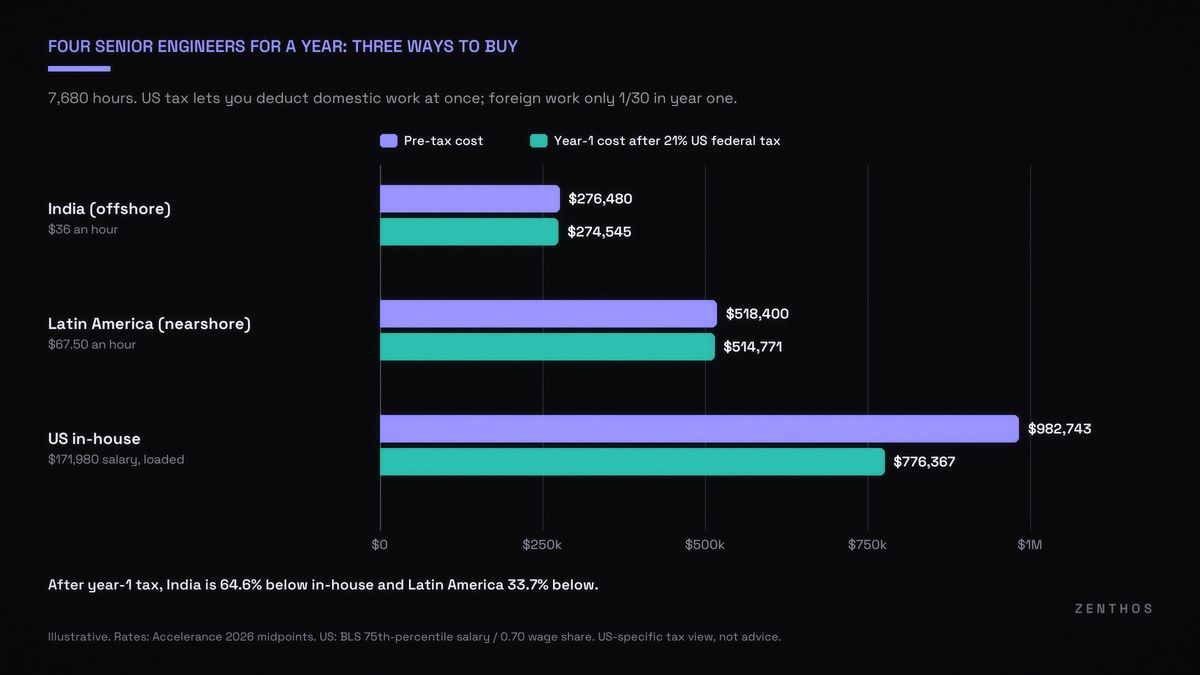
The tax rule shrinks both savings in year one. It hurts Latin America more in relative terms, because its margin over in-house was thinner to begin with.
Over the full 15 years you do get the deductions back. At an 8% discount rate, the delay costs about 8.5 cents per dollar of foreign spend. That is about $23,600 for the India team and $44,300 for the Latin America team.
The break-even is simple: $518,400 divided by $276,480 is 1.875. So the India team costs the same as the Latin America team only if the work takes 87.5% more hours. Time-zone friction is real, but it seldom adds that much.
If you prefer the median US salary of $135,980, in-house drops to $777,029. India still saves 64.4% before tax, and Latin America 33.3%.
Count the full 15 years of deductions at that 8% rate, and the gap narrows a little. India then comes to about $242,000 after tax, 68.8% below in-house. Latin America comes to about $454,000, 41.5% below.
UK and EU buyers can ignore the US tax rule and compare pre-tax prices. The same four seniors in Europe, at the $70 midpoint, cost $537,600. That is $261,120 more than the India team for the same hours.
The US tax rule most nearshore vs offshore comparisons miss
For US companies, nearshore and offshore get the same tax treatment. Both are foreign. Only work done inside the US gets the fast deduction.
The One Big Beautiful Bill Act, signed on 4 July 2025, added section 174A to the tax code. It lets you deduct domestic research and software development costs in the year you pay them. That applies to tax years starting after 31 December 2024.
Foreign work did not get that relief. Section 174 still says foreign research costs must be capitalised, meaning spread over time. You deduct them evenly over 15 years, starting from the middle of the year you pay.
The test is where the work happens, not who does it. Code written in Mexico City or Bogotá is foreign research, exactly like code written in Pune. The R&D tax credit also excludes research done outside the US.
- Year 1 deduction on foreign spend: 1/15 x 1/2 = 1/30 of the cost.
- Years 2 to 15: 1/15 each year.
- Year 16: the final 1/30.
This is general information about US federal tax, not advice. How your contract is written can change the result. Confirm the treatment with your CPA before you sign.
The real cost of time zones
Distance in hours does cut live conversation, but less than most people fear. A 2024 study from Rice, Harvard and Georgetown tracked messages among more than 12,000 staff at a Fortune 100 firm. One extra hour of time difference cut real-time communication by 11%.
The same study found people shifted some work outside normal hours to cope. That helps the team, but it is a cost someone pays. So plan your overlap, do not hope for it.
US clocks went back on 1 November 2026 and go forward on 14 March 2027. India and Colombia do not change clocks, and Mexico stopped in 2022. These are the winter gaps, with both sides working 9am to 6pm unless noted.
| Pairing | Winter gap | Overlap at 9am to 6pm | Realistic overlap |
|---|---|---|---|
| New York and India | India 10h30 ahead | None | 2.5 hours if India works 1pm to 10pm |
| Chicago and India | India 11h30 ahead | None | 1.5 hours; 2.5 if Chicago starts at 8am |
| Los Angeles and India | India 13h30 ahead | None | Under 1 hour: plan for async work |
| London and India | India 5h30 ahead | 3.5 hours | Up to 7.5 hours with a later India shift |
| Berlin or Paris and India | India 4h30 ahead | 4.5 hours | 4.5 hours or more |
| New York and Mexico City | Mexico 1h behind | 8 hours | 8 hours |
| New York and Bogotá | Same time | 9 hours | 9 hours |
| London and Warsaw | Warsaw 1h ahead | 8 hours | 8 hours |
Our read: an East Coast or European buyer can get 2 to 4 shared hours a day from India. A West Coast buyer mostly cannot. If your team sits in California and needs daily live sessions, nearshore is the honest answer.
How AI coding tools change the nearshore vs offshore decision
AI tools have made code cheaper to write and slower to review. That moves the bottleneck from typing to review and conversation, which is exactly where time zones bite.
Faros AI, which sells engineering-metrics software, studied telemetry from 22,000 developers for its April 2026 report. Comparing each firm's lowest and highest AI-use periods, median time in review rose 441.5%. Pull requests merged with no review at all rose 31.3%.
The same data shows real gains. Tasks finished per developer rose 33.7%. So the output is there, but it piles up waiting for a reviewer.
Independent data points the same way. Google's 2025 DORA report surveyed about 5,000 tech workers. It found 90% use AI at work, yet 30% have little or no trust in the code it writes.
If a review waits overnight, an offshore team loses a day each time. If the vendor commits in writing to 2 to 3 overlap hours and a review turnaround, most of that loss disappears. You keep a price near half of nearshore.
The same logic applies to AI projects themselves. Our guide to what an AI agent costs to build shows where review and testing time really goes.
Which model fits which work
Nearshore genuinely wins some jobs. Do not let any vendor, including us, talk you out of it when the work is mostly live conversation.
| Type of work | Best fit | Why |
|---|---|---|
| Discovery, workshops, fuzzy product ideas | Nearshore | Needs many live hours of back and forth |
| Daily pairing with a West Coast team | Nearshore | India overlap with California is under an hour |
| Regulated work needing staff on site or US-only access | In-house or US contractor | Location rules beat price |
| Well-specified builds, migrations, test automation | Offshore | Clear specs travel well; India costs about half the Latin America rate |
| DevOps, cloud cost work, overnight runs | Offshore | Time gap becomes a follow-the-sun advantage |
| Core IP and long-term architecture | In-house lead plus either | Keep the decisions inside; outsource the build |
Many buyers mix models. A small in-house core sets direction, and an offshore team builds against clear tickets. If you are getting ready for launch, our checklist on preparing your app for its first 1,000 users shows which tasks travel well.
2026 policy and currency risks
Three US policy moves get quoted in sales pitches. None of them is a reason to prefer nearshore over offshore today.
- HIRE Act: it proposes a 25% excise tax on payments to any foreign person for services that benefit US consumers, per RSM's analysis. That wording would catch Mexico and Colombia too. It is a bill, not law, and no vote has been held.
- The $100,000 H-1B fee: courts have blocked it and it is not being collected. It only touches workers you bring to the US, not a remote team.
- A new $103,265 H-1B fee: DHS proposed it on 25 August 2026 for cap-subject petitions. It is not final, and again it does not apply to remote work.
Currency matters more than most pitches admit. The rupee closed at 88.63 to the dollar on 12 November 2025 and at 94.04 on 12 November 2026. Your dollar now buys 6.1% more rupees.
If your contract is priced in dollars, that move helps your vendor's margins, not your budget. Ask for a rate review, or a rate lock for the next 12 months.
Nearshore currencies moved differently. ECB reference rates show the dollar buying 2.2% more Mexican pesos and 8.9% more Polish zloty than a year ago. The Colombian peso rose 20.7% against the dollar in 2026 up to late August, which can push Colombian vendors' dollar rates up.
Data rules in India are tightening, but foreign clients get a carve-out. Section 17(1)(d) of India's data protection act exempts data of people outside India processed under a contract with a foreign company. Security duties still apply, and the main rules start on 13 May 2027.
What to get in writing from an offshore software development company
A cheap rate is only cheap if the promises behind it are written down. Demand these from any offshore vendor, including us.
- Overlap hours: the exact shared hours in your time zone, for example 9am to 11:30am Eastern.
- Review turnaround: a maximum time for a pull request to get a first review, such as 4 working hours.
- Named seniors: the people on your account by name, with a notice period before any swap.
- IP assignment: all code and work product assigned to you on payment, with no reuse rights.
- Rate lock: a fixed dollar rate for 12 months, with a review if the currency moves more than 5%.
- Exit terms: a handover plan, full repo access from day one, and no fee to leave.
To compare two quotes side by side, download the outsourcing cost worksheet. It walks through the same steps as the example above.
Cloud bills are often the next surprise after the team is hired. If that is on your mind, read why your AWS bill is so high.
FAQ
Is nearshore or offshore software development cheaper?
Offshore is cheaper: Accelerance's 2026 survey puts senior developers in Asia at $31 to $41 an hour and in Latin America at $60 to $75. In our four-engineer example, India cost $276,480 a year and Latin America $518,400. Nearshore buys more overlap hours, not lower cost.
How much does offshore software development cost per hour?
In 2026, Accelerance's survey of 60 partner firms found Asia rates of $24 to $31 an hour for junior developers and $31 to $41 for seniors. Rates fell nearly 8% in a year. Expect quotes above this range for niche skills, and check whether the price includes project management.
Can I deduct offshore development costs in the US?
Yes, but slowly: US companies must spread foreign software development costs over 15 years, with only 1/30 deductible in year one. Work done inside the US is deductible right away, and nearshore countries count as foreign too. This is not tax advice, so confirm with your CPA.
How many hours of overlap do I need with an offshore team?
Two to three shared hours a day is enough for most well-specified work, used for standups, reviews and unblocking questions. From India, East Coast and European buyers can get this. West Coast buyers usually get under an hour, so they need strong async habits or a nearshore team.
Is nearshore better for agile teams?
Often, yes, when the team holds many live ceremonies and changes direction weekly. Nearshore gives 7 to 9 shared hours with US buyers. Agile teams with clear tickets and a written review turnaround can work well offshore with 2 to 3 hours of overlap, at roughly half the price.
Will the HIRE Act tax outsourcing?
Not yet: the HIRE Act would add a 25% excise tax on payments to foreign service providers, and deny the deduction. As of November 2026, it has not passed either chamber and no vote has been held. As drafted, it would hit nearshore vendors in Mexico or Colombia as hard as offshore ones.
Talk to us before you sign
If your work is discovery-heavy or your team sits on the West Coast, a nearshore team may serve you better, and we will say so. If the work is well-specified, offshore can halve the bill once the overlap and review promises are written down.
We build web and mobile products, run DevOps and cloud work, and ship agentic AI systems for clients worldwide. Send us your scope and time zone for a free consultation. We will tell you honestly whether offshore fits, and what we would put in writing.