
Voice AI vendors will quote you about $0.10 a minute. The number is real, but it is the wrong one to budget with. When a cheap AI minute fails and the call goes to a human, you pay for both.
Gartner's January 2026 forecast says generative AI will cost more than $3 per resolved customer service issue by 2030. That is more than many offshore human agents cost. Meanwhile, searches for "AI call center" grew more than 80-fold in a year, to 33,100 a month.
This guide prices each layer from vendor pages checked on 23 September 2026. Then it shows how to work out your cost per resolved call and your break-even point.
What does an AI call center cost in 2026?
An AI call center costs about $0.07 to $0.31 per minute of AI talk time on managed platforms, at list prices checked 23 September 2026. A self-built stack runs about $0.04 to $0.10. Counting failed calls that reach a human, the example below resolves a 4-minute call for about $0.80 to $2.45.
Two things drive that spread: the model you run, and how many calls the AI finishes on its own. The second matters far more.
This guide is for contact centers with queues and dozens of seats. If you run a single front desk, our AI receptionist cost guide is a better fit.
The AI voice agent cost stack, layer by layer
Every minute of an AI voice agent pays up to five suppliers. The platform fee is usually the biggest line, not the AI model. Prices below are from public price lists, checked 23 September 2026.
| Layer | What it does | Price per minute | Example list prices (23 Sep 2026) |
|---|---|---|---|
| Telephony | Carries the call over the phone network | $0.005–$0.022 | Twilio US inbound $0.0085 local, $0.022 toll-free; Retell $0.015; Telnyx via Vapi $0.0055 |
| Speech-to-text | Turns the caller's voice into text | $0.005–$0.010 | Deepgram Nova-3 $0.0048–$0.0058; Deepgram Flux $0.0065; Deepgram via Vapi $0.0095 |
| Language model (LLM) | Decides what to say and which system to query | $0.005–$0.16 | Gemini 3.1 Flash-Lite ~$0.005; Gemini 3.8 Flash ~$0.014; Retell's model menu $0.0016–$0.16 |
| Text-to-speech | Turns the reply into a voice | $0.012–$0.04 | Deepgram Aura-2 ~$0.012; ElevenLabs Flash ~$0.021; Retell $0.015–$0.040 |
| Platform fee | Runs turn-taking, interruptions, transfers and logs | $0.05–$0.08 | Vapi $0.05; Retell $0.055; Cartesia $0.06; ElevenLabs Agents $0.08 |
| Total, managed platform | All of the above on one bill | $0.07–$0.31 | Retell's stated range; Bland $0.12–$0.14 talk time; Synthflow not published |
| Total, self-built | You run the orchestration software | about $0.04–$0.10 | Before engineering, hosting and monitoring |
Sources: Retell's pricing page, Deepgram's pricing page, Google's Gemini API pricing and the other vendors' own pricing pages. Synthflow publishes no per-minute rate; its enterprise contracts start at $30,000 a year.
Two layers are priced in tokens or characters, so they need converting. These are the assumptions behind the table:
- Language model (LLM): a caller takes about 4 turns a minute. Each turn resends a 3,000-token prompt plus the conversation so far, about 4,200 tokens in all. That is about 16,800 input tokens and 240 output tokens a minute.
- At Gemini 3.8 Flash prices of $0.75 per million input tokens and $3.75 per million output tokens, that minute costs about $0.014. Prompt caching can cut it further.
- Text-to-speech: the agent talks about half the time, at about 150 words a minute. That is about 410 characters per call minute.
Google's price page shows where Gartner's worry comes from. The Gemini 3.8 Flash price holds only until 31 December 2026. On 1 January 2027 it doubles, and your $0.014 model minute becomes about $0.027.
Managed platform or build your own?
Below about 100,000 AI minutes a month, buy a managed platform. Above that, the platform fee alone starts to pay for a small engineering team.
The arithmetic is simple. At 240,000 minutes a month, a $0.05 platform fee is $12,000 a month, or $144,000 a year. Building means you own latency, uptime, failover and every carrier quirk. Our guide to AI agent development cost breaks down what that build usually takes.
Watch the fixed fees too. Retell includes 20 simultaneous calls, then charges $8 a month for each extra one. Bland's Build plan costs $299 a month and caps you at 50 simultaneous calls.
Per-minute vs per-resolution: the AI call center number that matters
Cost per resolved call is the only number that tells you whether AI saves money. It counts the AI minutes spent on calls that end up with a human anyway.
The key input is containment rate, the share of calls the AI finishes without a human. The sum has three parts:
- AI cost per call: AI minutes on calls it finishes, plus AI minutes on calls it hands off, times the AI price.
- Human cost per call: the share of calls handed off, times human minutes, times the human cost per minute.
- Cost per resolved call: the two added together, since every call ends up resolved somewhere.
Vendor comparisons skip the second line. Retell, which sells voice agents, puts a 4-minute AI call at $0.28 to $0.60 against $3 to $7 for a human. That assumes the AI resolves every call it answers.
Worked example: a 40-seat center
Take an illustrative 40-seat center that handles 60,000 inbound calls a month. Each call averages 4 minutes, so that is 240,000 minutes. The inputs:
- AI price: $0.15 a minute all-in, the middle of the managed range above.
- Failed AI calls: the AI spends 2 minutes before it hands the call to a human.
- Human handling: the agent then takes the full 4 minutes. That assumes the handoff passes the context, so the caller does not start over.
- Onshore human: $35 an hour, the US in-house rate in rethinkCX's May 2026 BPO cost index. At 80% occupancy, the share of paid time spent on calls, that buys 48 call minutes. So $35 ÷ 48 = $0.73 a minute.
- Offshore human: $12 an hour, the Philippines mid-market rate in the same index. $12 ÷ 48 = $0.25 a minute.
Now the steps.
- All-AI minutes: 240,000 × $0.15 = $36,000 a month. This is the vendor slide. Across the full price range it is $16,800 to $74,400.
- All-human: onshore, 240,000 × $0.73 = $175,200. Offshore, 240,000 × $0.25 = $60,000. That is $2.92 and $1.00 a call.
- AI cost per call: a call the AI finishes costs 4 × $0.15 = $0.60. A failed one costs 2 × $0.15 = $0.30. At 50% containment: 0.5 × $0.60 + 0.5 × $0.30 = $0.45.
- Add the humans: at 50% containment with an offshore team, 0.5 × $1.00 = $0.50. Total: $0.45 + $0.50 = $0.95 a call.
- Break-even: solve $0.30 + $0.30 × c + (1 − c) × human cost = human cost. Offshore, c = 0.30 ÷ 0.70 = 43%. Onshore, c = 0.30 ÷ 2.62 = 11%.
| Scenario | Onshore team, per call | Onshore team, per month | Offshore team, per call | Offshore team, per month |
|---|---|---|---|---|
| All human | $2.92 | $175,200 | $1.00 | $60,000 |
| AI at 30% containment | $2.43 | $146,040 | $1.09 | $65,400 |
| AI at 50% containment | $1.91 | $114,600 | $0.95 | $57,000 |
| AI at 70% containment | $1.39 | $83,160 | $0.81 | $48,600 |
| Break-even containment | 11% | n/a | 43% | n/a |
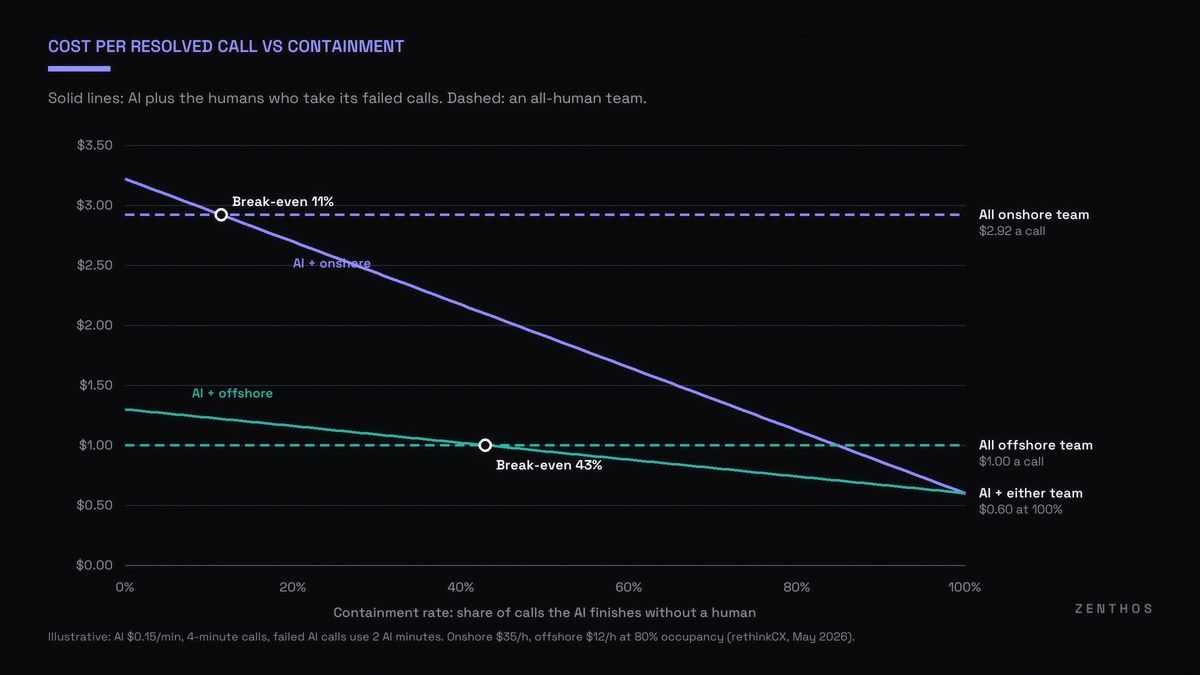
Against an onshore team, AI wins almost at once. It breaks even at about 11% containment, and at 70% it saves $92,000 a month.
Against an offshore team, it is close. Below about 43% containment, AI makes each call more expensive, not less. At 30%, you pay $5,400 a month more than the all-offshore team.
Now look at AI spend per call the AI actually resolves. At 30% containment that is $0.39 ÷ 0.3 = $1.30. That is more than double the $0.60 on the vendor slide.
Price rises hit hard. If the AI minute costs $0.30, a fully contained 4-minute call costs $1.20. That is more than the $1.00 offshore human call, so no containment rate breaks even. This is the mechanism behind Gartner's 2030 warning.
What AI voice agents handle well, and where they fail
AI voice agents do well on short calls with one clear goal and a clear finish. They struggle with anger, several problems in one call, and anything where a wrong answer costs money.
The evidence points the same way. A Gartner survey of 5,728 customers, published in August 2024, found only 14% of service issues were fully resolved in self-service. Even for issues customers called very simple, the figure was only 36%. The most common failure was not finding content relevant to the problem.
Your AI is only as good as the answers and system access behind it. If your knowledge base is thin, containment will be too.
Named deployments tell the same story:
- Klarna said its AI assistant handled two-thirds of customer chats in its first month, in February 2024. By May 2025 its CEO said the company had gone too far and started hiring humans again. That was chat, not voice, but the pattern carries over.
- Taco Bell put voice AI in more than 500 drive-thrus and took over 2 million orders. In August 2025 it said it was rethinking where the tool fits, noting that busy restaurants may do better with a human.
- McDonald's ended its voice-ordering test with IBM in June 2024, after complaints about wrong orders.
Speed is the hidden failure. A 2009 PNAS study of 10 languages found the most common gap before a reply is under 200 milliseconds. Every layer in the cost stack adds delay. When the gap stretches to a second, callers talk over the agent and the call derails.
| Call type | Fit for AI | Why |
|---|---|---|
| Order, delivery or claim status | Strong | One question, one lookup, clear end |
| Booking and rescheduling | Strong | Structured steps, easy to confirm back to the caller |
| After-hours triage and messages | Strong | The alternative is voicemail or a missed call |
| Taking payments | Medium | Works, but card data rules (PCI DSS) shape the whole design |
| Billing disputes and refunds | Weak | Needs judgment, policy exceptions and often a goodwill offer |
| Complaints and angry callers | Weak | Callers want to be heard by a person, and escalation costs trust |
| Hardship, collections, vulnerable callers | Weak | Regulated conversations where a wrong word creates legal risk |
| Calls with several problems at once | Weak | Containment drops as each extra intent adds a failure point |
The cheapest contact center AI win: calls you already record
Post-call analytics is often the cheapest, lowest-risk first AI project in a call center. That means transcribing recorded calls and checking them afterwards. No caller waits on the AI, and a mistake never reaches a customer.
We ran this for a consumer-lending collections operation: about 2,750 recorded calls, or 90 hours of phone audio, a day. It used a hosted multimodal LLM, one that takes audio directly. Moving to a self-hosted open-source pipeline cut the monthly transcription-and-analysis bill from about $1,680 to roughly $55 of electricity.
That $55 is marginal cost only; it leaves out engineering time. Per call, it went from about 2 cents to under a tenth of a cent.
What the business gets for that money:
- 100% quality assurance (QA) coverage, instead of a supervisor sampling a few calls per agent.
- Compliance checks on every call, such as whether required statements were read out.
- Promise-to-pay extraction, pulling the amount and date a borrower agreed to into structured data.
- Your real call-reason mix, which is exactly the input the containment maths above needs.
Two lessons from that project apply to any contact center:
- Transcribe once, then analyse the text. The old setup sent the same audio to the model separately for each task. Transcribing once would have roughly halved the hosted bill on its own.
- Audio quality and language mix decide accuracy. Narrowband 8kHz phone audio, callers switching between Hindi and English mid-sentence, and cross-talk broke the speech models that top public leaderboards. A regional model trained on Indian languages beat them all.
The full model comparison is in our open-source speech-to-text review.
How to staff a hybrid AI call center
Plan for fewer calls, but harder ones. Your people will take longer per call, and you will cut fewer seats than the containment rate suggests.
ContactBabel data shows the average service call grew from 3 minutes 55 seconds in 2003 to 5 minutes 12 seconds in 2018. Web self-service took the simple calls and left agents the hard ones.
Queue maths makes it sharper. Say the busiest hour in the worked example brings 250 calls at 4 minutes each. To answer 80% of calls within 20 seconds, the standard queue formula (Erlang C) says you need 21 agents on the phones.
At 50% containment, 125 calls reach humans. If the harder mix pushes handle time to 5 minutes, you still need 14 agents. Half the calls went away, but only a third of the agents did.
Most leaders are already planning this way. A Gartner survey of 321 service leaders, published in April 2026, found 85% are adding responsibilities to human agents. Only 31% had made or planned AI-driven layoffs through early 2027.
Give your people AI too. A study of 5,179 support agents in the Quarterly Journal of Economics found an AI assistant raised issues resolved per hour by 14%. For new and less skilled agents, the gain was 34%.
Where the AI customer service agent fits, and where people do
- AI takes: status checks, bookings, simple account changes, after-hours triage, and the first minute of identity checks.
- People take: complaints, disputes, hardship and vulnerable callers, multi-problem calls, and high-value sales.
- Both share: the handoff. The AI passes a summary, and the human sees it before saying hello.
We make the longer case for this split in why AI makes your support team stronger.
A phased rollout
- After-hours and overflow first. The AI answers calls that would otherwise hit voicemail or ring out. Anything it resolves is pure gain, because the baseline is zero.
- One call reason in business hours. Pick the highest-volume, simplest reason. Track containment, transfers, and repeat calls within seven days.
- Expand one reason at a time. Add the next only when the last one holds above your break-even rate for a full month.
Compliance: disclosure, consent and recording
Tell callers they are talking to AI at the start of every call. It is required in the EU from August 2026, and it is the safe default across the US. This summary is not legal advice; check it with counsel for your markets.
| Jurisdiction and rule | What it says | What it means for you |
|---|---|---|
| US federal: FCC ruling, February 2024 | AI-generated voices count as artificial voices under the Telephone Consumer Protection Act | Outbound AI calls need prior express consent, like robocalls |
| EU AI Act, Article 50, from 2 August 2026 | People must be told they are dealing with AI unless it is obvious | Disclose at the start of each call; fines reach €15 million or 3% of turnover |
| California AB 2905 (2024) | Autodialed calls must say if the message uses an AI voice | Covers automated outbound calls in California |
| Utah SB 226 (May 2025) | Disclose AI if asked; say it up front in high-risk talks like financial advice | Answer "am I talking to a robot?" truthfully, every time |
| All-party recording consent states | About a dozen states, including California, Florida and Illinois | Your AI records every call, so announce recording at the start |
The two anchor rules are primary documents: the FCC's February 2024 declaratory ruling and the European Commission's Article 50 guidance. The EU's Digital Omnibus delayed other parts of the AI Act, but not the chatbot disclosure duty.
In the US, outbound calling carries the most risk. Inbound AI answering is lower risk, but disclosure and recording rules still apply.
Questions to ask an AI call center vendor
Ask for numbers you can put into the worked example above.
- What is your price per resolved call on work like ours? Ask for the containment rate behind any per-minute quote.
- What counts as resolved? A call that ends without a transfer is not resolved if the customer calls back tomorrow. Ask for the repeat-call rate within seven days.
- How does transfer work? The human should get the transcript and the reason. Also ask if transfer time is billed; Bland charges $0.04 to $0.05 a minute.
- What is response time at our peak volume? Ask for the slowest 5% of turns under load, not a demo average. Check simultaneous-call limits too.
- Do you keep our recordings, and does anyone train on them? Get retention periods and a no-training clause into the contract.
- How do we leave? Confirm you can export prompts, call flows, transcripts and phone numbers, and check the minimum term.
To run these numbers for your own center, download the AI call center cost worksheet. It puts the worked example's formulas on one page.
FAQ
How much does an AI voice agent cost per minute?
Managed AI voice agent platforms charge about $0.07 to $0.31 a minute, based on list prices checked on 23 September 2026. Retell lists $0.07 to $0.31, and Bland charges $0.12 to $0.14 a minute of talk time. Building your own stack costs about $0.04 to $0.10 a minute, before engineering and hosting.
Can AI replace call center agents?
Not fully, and few companies are trying. A Gartner survey published in April 2026 found 85% of service leaders are adding responsibilities to human agents. Only 31% had made or planned AI-driven layoffs. The practical model is hybrid: AI takes simple calls, and people take complex, emotional and high-stakes ones.
What is a good containment rate for an AI call center?
A good containment rate is one above your own break-even point, not a fixed industry number. In this guide's example, break-even is about 11% against onshore agents and 43% against offshore agents. Measure it per call reason, and count a repeat call within seven days as a failure.
Is an AI call center cheaper than offshore agents?
Only above a certain containment rate. With AI at $0.15 a minute and an offshore agent at $12 an hour, AI breaks even at about 43% containment. If the AI price rises to $0.30 a minute, it never breaks even on a 4-minute call. Gartner expects AI costs to rise by 2030.
Do I have to tell callers they are talking to AI?
In the EU, yes. The AI Act requires it from 2 August 2026 unless it is obvious. In the US, rules vary by state and call type; Utah, for example, requires it whenever a caller asks. Disclosing at the start of every call is the simplest safe default. This is not legal advice.
What is the cheapest way to start with contact center AI?
Start with post-call analytics on calls you already record. It checks every call for quality and compliance, and no customer ever waits on the AI. One collections operation we worked with cut its monthly analysis bill from about $1,680 to $55 of electricity by moving to self-hosted open-source models.
Get your cost per resolved call before you sign
The per-minute price is the easy part. The number that decides your business case is what a resolved call costs once transfers, repeat calls and longer human calls are counted.
Our voice AI team builds voice agents and post-call analytics. For agents that act inside your CRM or billing system, see agentic AI development. For speech and language models tuned to your calls, see AI and machine learning.
Send us a month of call-reason data and we will estimate your cost per resolved call. Book a free consultation to start.